
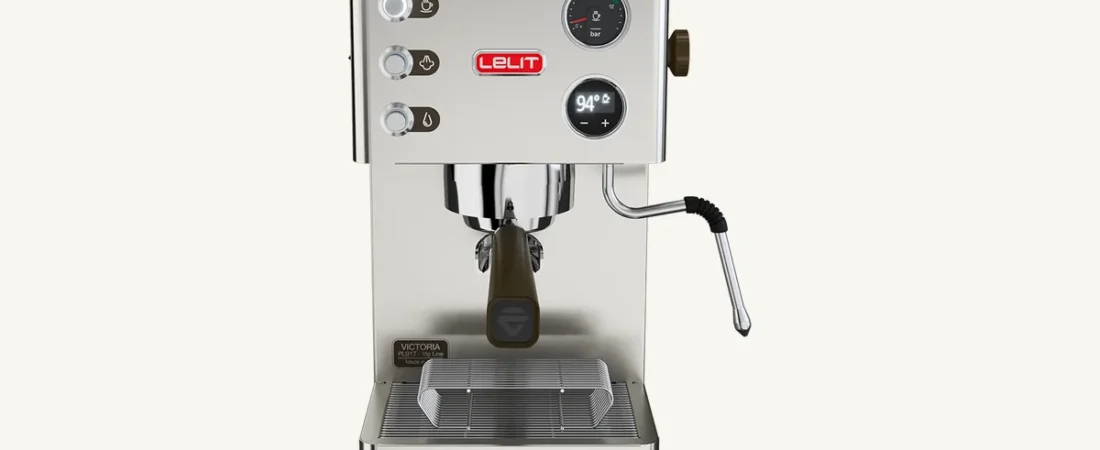
The best espresso machine under $1,000 is the one that gives you control over the three variables that separate a café-quality shot from a sour or bitter one: brew temperature, puck preparation and shot timing. Between roughly $500 and $1,000 you finally get real tools for those jobs. This is the band where PID controllers, 58mm portafilters, brass boilers and shot timers become standard equipment.
This guide is for aspiring home baristas who want a machine they can learn on for years. We compared eight current US models using manufacturer spec pages and manuals, live retailer listings at Amazon.com, Seattle Coffee Gear, Whole Latte Love and the brands’ own stores, and the owner ratings on those pages. We did not lab-test these machines; every price and spec below comes from a page we opened in November 2026, and anything we could not confirm was left out.
Quick Verdict: The Best Espresso Machines Under $1,000 at a Glance
Prices are approximate US prices at the time of writing (November 2026). Several were on Black Friday sale, so confirm the live price.
| Product | Best for | Key spec | Approx. US price | Buy |
|---|---|---|---|---|
| Lelit Victoria PL91T | Best overall for aspiring baristas | 58mm group, PID via LCC display, built-in shot timer | ~$799.96 (list $999.95) | Check Price |
| Breville Barista Pro | Best all-in-one with grinder | ThermoJet + PID, 30-setting grinder, LCD | ~$629.95 (list $849.95) | Check Price |
| Rancilio Silvia | Best for long-term durability | 12 oz brass boiler, 58mm group, 3-way solenoid | ~$995 | Check Price |
| Lelit Anna PL41TEM | Best budget PID single boiler | PID display, 250 ml brass boiler, pressure gauge | ~$599.95 list (seen at $479.95) | Check Price |
| Gaggia Classic Pro E24 | Best entry to the 58mm standard | Brass boiler, 9-bar OPV, 58mm portafilter | ~$449.76–$499 | Check Price |
| Breville Barista Express Impress | Best assisted workflow | Assisted tamp, auto-dose correction, PID | ~$794.99 | Check Price |
| Flair 58 Plus 2 | Best for shot control (no steam) | Manual lever, 58mm, 3-step preheat, gauge | ~$559 sale (reg. $699) | Check Price |
| Breville Bambino Plus | Best for milk drinks at the $500 line | Auto steam wand, pre-infusion, 54mm | ~$499.95 | Check Price |
How We Researched This: Our 5-Pillar Method
How We Researched This
Caffro is a research-based publication, not a testing lab. For this roundup we screened candidates against the three features serious beginners ask about most (a commercial 58mm group, PID temperature stability and a shot timer) and then scored every finalist on five factors:
- OEM spec & manual verification: boiler, heating, portafilter, tank and power figures from manufacturer pages, technical sheets and manuals, cross-checked against US retailers.
- SCA certification check: the SCA Certified Home Brewer program covers drip brewers, not espresso machines, so it did not affect this ranking.
- Owner-review synthesis: our method draws on Amazon, Reddit (r/espresso) and Home-Barista owner feedback; every rating, review count and owner theme quoted in this guide comes from the Amazon.com or specialist-retailer listing we name next to it.
- Failure-mode & durability audit: boiler material, solenoid valves, group standardization, warranty terms and parts availability.
- 3-year cost of ownership: the machine plus the grinder, scale, filters and gaskets most buyers add.
We only quote ratings and review counts we read ourselves on the listing pages in November 2026. We do not assign numeric scores we cannot back up.
We focused on the $500 to $1,000 band. Two picks sit at its floor (the Gaggia Classic Pro E24 and Bambino Plus) because they leave money for a proper grinder. Machines just above the ceiling, such as the $1,119 Rancilio Silvia PID, were left out on price. If you are still deciding whether you need this tier at all, our guide to the best home espresso machine covers the full range, and our roundup of the best espresso machines under $500 covers the tier below.
1. Lelit Victoria PL91T: Best Overall

The Lelit Victoria is the only machine in this guide that ticks all three boxes aspiring baristas ask about: a commercial 58mm group, PID temperature control and a built-in shot timer. Lelit’s US store listed it at $799.96 (list $999.95) at the time of writing; Seattle Coffee Gear showed $799.95 but was out of stock.
Engineering Specs & Key Metrics
| Spec | Lelit Victoria PL91T |
|---|---|
| Boiler | 300 ml brass, single boiler |
| Group | LELIT58 commercial group, 58mm |
| Temperature control | PID via Lelit Control Center (LCC), OLED display |
| Shot timer | Yes, brewing chronometer on the LCC display |
| Pre-infusion | Yes, can be activated in the LCC |
| Pressure gauge | Back-lit manometer |
| Solenoid | 3-way solenoid valve |
| Water tank | 2.5 L |
| Power | 1,200 W (120 V) |
| Warm-up | About 6 minutes (Seattle Coffee Gear) |
| Dimensions | 23 × 38 × 38 cm (Lelit) |
| Weight | 11.3 kg |
Thermal Architecture & Extraction Analysis
The Victoria’s heart is a 300 ml brass boiler paired with Lelit’s LELIT58 commercial group. Temperature is managed by the Lelit Control Center (LCC). According to Lelit, its OLED display shows coffee, water and steam temperature and the brewing ascending time, which is a shot timer that starts when you begin extraction. It also enables pre-infusion, standby and an automatic cleaning cycle.
For a learner that combination is powerful. You can adjust brew temperature for each roast, read the extraction time on the display, and watch the manometer to see whether the shot is choking or gushing. The 58mm group means accessories you buy now will carry over to a future machine.
The trade-off is steam. Seattle Coffee Gear rates the Victoria’s steam power as modest, best suited to 8 to 10 oz drinks, and you wait for the single boiler to change temperature between brewing and steaming.
What We Liked vs. What We Didn’t
Pros
- 58mm group, PID and a shot timer in one machine under $1,000
- Programmable pre-infusion, rare at this price
- Back-lit pressure gauge plus temperature and time on one display
Cons
- Modest steam power; slow for back-to-back lattes
- Small owner-review pool at Seattle Coffee Gear (3.7 out of 5 from 9 reviews), with complaints about weak steam, awkward tank access and occasional reliability issues
- Price swings by about $200 depending on whether a sale is running
Who Should NOT Buy the Lelit Victoria
- The four-latte household: if you steam milk for several drinks every morning, a single boiler will slow you down.
- The one-button commuter: if you want espresso without dialing in, the LCC’s settings are more than you need.
Better fit: compare dual-boiler and heat-exchanger options in our guide to the best prosumer espresso machines.
2. Breville Barista Pro: Best All-in-One with a Grinder
If your $1,000 has to cover the grinder too, the Barista Pro is the strongest all-in-one in this band. Breville lists it at $849.95, and it was $629.95 on Amazon.com in a Black Friday deal at the time of writing, with 4.4 out of 5 stars from 3,461 ratings.
Engineering Specs & Key Metrics
| Spec | Breville Barista Pro (BES878) |
|---|---|
| Heating | ThermoJet, extraction temperature in 3 seconds (Breville) |
| Temperature control | PID, adjustable shot temperature |
| Grinder | Integrated conical burr, 30 grind settings |
| Pump / extraction | 15-bar pump, low-pressure pre-infusion, then 9-bar extraction |
| Portafilter | 54mm stainless steel |
| Display | LCD with grind and extraction progress |
| Water tank | 68 fl oz (2 L), removable |
| Power | 1,680 W |
| Dimensions (W × D × H) | 16.1 × 13.8 × 13.1 in |
Thermal Architecture & Extraction Analysis
The Barista Pro uses Breville’s ThermoJet heater, which the manual says reaches extraction temperature in 3 seconds, paired with PID control and an adjustable shot temperature setting. Because it heats on demand, the switch from shot to steam is fast. Extraction starts with low-pressure pre-infusion before rising to 9 bar, delivered by a 15-bar pump.
The LCD is the reason this machine suits learners. It shows grinding and extraction progress, and the manual describes a timer that counts up while the grinder doses so you can repeat the same dose. Grind size, grind amount, shot temperature and pre-infusion are adjustable from the menu.
The compromises are the 54mm portafilter and a built-in grinder you cannot upgrade separately.
What We Liked vs. What We Didn’t
Pros
- Grinder, PID and fast heat-up in one footprint
- Large owner base: 3,461 Amazon ratings at 4.4 stars
- Dedicated hot-water outlet for Americanos and cup preheating
Cons
- 54mm portafilter limits accessory choice compared with 58mm
- Integrated grinder cannot be upgraded later
- More electronics to fail over the long term than a simple boiler machine
Who Should NOT Buy the Breville Barista Pro
- The light-roast specialist: if you mostly buy very light single origins, a dedicated espresso grinder paired with a 58mm machine like the Victoria gives you more headroom.
- The tinkerer who wants to repair everything: simpler boiler machines like the Rancilio Silvia are easier to service for decades.
Better fit: see our De’Longhi La Specialista Touch review for an all-in-one with automatic milk texturing.
3. Rancilio Silvia: Best for Long-Term Durability
The Rancilio Silvia has been in production for over 20 years, according to Seattle Coffee Gear, and it remains the default answer for buyers who want a machine they can keep running for a decade or more. It was $995 at Seattle Coffee Gear, Whole Latte Love and Amazon.com at the time of writing. That puts it right at our ceiling, and it is the only machine near this price without a factory PID.
Engineering Specs & Key Metrics
| Spec | Rancilio Silvia |
|---|---|
| Boiler | Single 12 oz brass boiler |
| Group | 58mm, commercial-size portafilter |
| Temperature control | Thermostat (no factory PID) |
| Solenoid | 3-way solenoid, backflush capable |
| Water tank | 2 L |
| Power | 1,100 W (120 V) |
| Warm-up | About 3.5 minutes for the boiler (Seattle Coffee Gear) |
| Dimensions (W × H × D) | 9.5 × 13.5 × 11 in |
| Warranty | 1 year (Seattle Coffee Gear listing); 2-year limited (Whole Latte Love listing) |
Thermal Architecture & Extraction Analysis
The Silvia is deliberately simple: a 12 oz brass boiler, a heavy 58mm group and a 3-way solenoid that allows backflushing. Without a PID, the boiler temperature is governed by a thermostat that cycles on and off, so brew temperature moves within a band. Owners manage this with temperature surfing: flushing the group and pulling at the same point in the heating cycle.
Seattle Coffee Gear recommends giving the heavy brass group extra warm-up time beyond the boiler’s 3.5 minutes. Its separate, retailer-installed Silvia PID version adds a PID, pre-infusion and a shot timer, but costs $1,119.
In the 196 reviews on Seattle Coffee Gear’s page (4.4 out of 5), the recurring praise is longevity, with several owners reporting 15 to 20 years or more of use. The complaints are a steep learning curve, temperature inconsistency, a small drip tray and no PID at $995. Some owners note production has moved from Italy to Spain; Seattle Coffee Gear says it has not observed quality differences.
What We Liked vs. What We Didn’t
Pros
- Proven, long-lived design with a large repair knowledge base
- Commercial 58mm group and 3-way solenoid
- Few electronics to fail
Cons
- No PID, pre-infusion or shot timer at nearly $1,000
- Thermostat-driven temperature swings reward a strict routine
- Small drip tray, according to an owner review
Who Should NOT Buy the Rancilio Silvia
- The light-roast explorer: without adjustable temperature, light roasts are harder to dial in.
- The data-driven learner: there is no gauge display or shot timer, so you will need a scale with a timer to track your shots.
Better fit: see our Rancilio Silvia vs. Profitec Go comparison before you decide.
4. Lelit Anna PL41TEM: Best Budget PID Single Boiler
The Lelit Anna PL41TEM is the least expensive brass-boiler machine with a factory PID in this guide. Seattle Coffee Gear lists it at $599.95 and showed a $479.95 sale price at the time of writing, although it was out of stock there when we checked.
Engineering Specs & Key Metrics
| Spec | Lelit Anna PL41TEM |
|---|---|
| Boiler | 250 ml brass |
| Temperature control | PID with display |
| Group | LELIT57 group, 57mm |
| Pressure gauge | Yes, manometer |
| Solenoid | 3-way solenoid valve |
| Water tank | 2.7 L with side level window |
| Power | 1,050 W (120 V) |
| Warm-up | About 10 minutes (Seattle Coffee Gear) |
| Dimensions | 23 × 38 × 34 cm (Lelit) |
| Weight | 7.5 kg |
Thermal Architecture & Extraction Analysis
The Anna pairs a small 250 ml brass boiler with a PID controller and display, so you set the boiler temperature directly instead of surfing a thermostat. Lelit adds a manometer, a 3-way solenoid valve and a 2.7 L tank, the largest in this guide.
Two caveats: the Anna uses Lelit’s 57mm group, so check accessory fit, and there is no shot timer or pre-infusion, so pair it with a timer scale. Seattle Coffee Gear rates its steam power as modest.
What We Liked vs. What We Didn’t
Pros
- Factory PID on a brass boiler for well under $1,000
- Pressure gauge and 3-way solenoid
- Large 2.7 L tank in a compact body
Cons
- 57mm group has a narrower accessory ecosystem than 58mm
- No shot timer or pre-infusion
- Very small owner-review pool on the US retailer page we checked
Who Should NOT Buy the Lelit Anna
- The accessory collector: if you want the widest choice of precision baskets and tools, the 57mm group will frustrate you.
- The milk-drink household: a 250 ml boiler with modest steam is slow for several cappuccinos in a row.
Better fit: see more machines in our home espresso section.
5. Gaggia Classic Pro E24: Best Entry to the 58mm Standard
The Gaggia Classic Pro E24 sits at the very bottom of this price band, and that is the point. It was $449.76 on Amazon.com and $499 at Whole Latte Love (regular price $549) at the time of writing, with 4.3 out of 5 stars from 3,229 Amazon ratings. It leaves hundreds of dollars for a proper espresso grinder.
Engineering Specs & Key Metrics
| Spec | Gaggia Classic Pro E24 |
|---|---|
| Boiler | Single brass boiler (new in the E24) |
| Group | 58mm brass group, stainless steel portafilter |
| Pressure | 9-bar over-pressure valve (OPV) |
| Solenoid | 3-way solenoid valve |
| Steam | Commercial-style wand, 2-hole tip |
| Water tank | 72 fl oz, removable |
| Power | 1,425 W |
| Weight | 20 lb |
| Warranty | 2-year parts and labor (Whole Latte Love) |
Thermal Architecture & Extraction Analysis
The E24 update replaced the Classic’s aluminum boiler with brass. Whole Latte Love says brass has more mass than aluminum, so it holds temperature more consistently, and that the new boiler also has a larger internal capacity for better steaming and more consecutive drinks. The updated OPV limits extraction to 9 bar.
There is no PID from the factory, so like the Silvia you will get the most consistent results with a repeatable routine. What you do get is the same 58mm standard as machines costing twice as much. Whole Latte Love’s listing shows a pressurized basket in the box alongside standard ones, so you can start with pre-ground coffee.
What We Liked vs. What We Didn’t
Pros
- Least expensive 58mm machine in this guide
- Brass boiler, 9-bar OPV and 3-way solenoid
- Large owner base and a 2-year warranty from Whole Latte Love
Cons
- No PID, pre-infusion or shot timer
- Single boiler means waiting between brewing and steaming
- Plastic tamper in the box, per Whole Latte Love’s listing
Who Should NOT Buy the Gaggia Classic Pro E24
- The set-and-forget brewer: if you do not want to learn a temperature routine, a PID machine like the Lelit Anna is easier to get consistent.
- The buyer with no grinder budget: the Gaggia needs a capable burr grinder to shine.
Better fit: the Lelit Anna above, paired with a capable burr grinder.
6. Breville Barista Express Impress: Best Assisted Workflow
The Barista Express Impress is built for the buyer who wants to make real espresso without fighting dose and tamp consistency on day one. Breville lists it at $799.95, and it was $794.99 on Amazon.com at the time of writing, with 4.2 out of 5 stars from 1,659 ratings.
Engineering Specs & Key Metrics
| Spec | Breville Barista Express Impress (BES876) |
|---|---|
| Grinder | Integrated conical burr, 25 grind settings |
| Dosing | Intelligent dosing that auto-corrects the next dose |
| Tamping | Assisted tamp, constant 22 lb with a 7° finishing twist |
| Heating | Thermocoil with PID, water delivered at 200°F (Breville) |
| Pump / extraction | 15-bar pump, low-pressure pre-infusion, then 9-bar extraction |
| Portafilter | 54mm stainless steel |
| Water tank | 2 L (Amazon listing) |
| Dimensions (W × D × H) | 16.6 × 14.4 × 12.2 in |
Thermal Architecture & Extraction Analysis
Breville’s Impress Puck System is the headline. A lever applies a constant 22 lb tamp and finishes with a 7° twist, and the machine remembers the outcome of each tamp and adjusts the next dose up or down. That removes two hard variables for beginners while leaving grind size and shot length in your hands.
Heating is handled by a Thermocoil with PID control that Breville says delivers water at 200°F. It uses low-pressure pre-infusion and a 54mm portafilter, and Breville does not list a digital shot timer on the product page we read.
What We Liked vs. What We Didn’t
Pros
- Assisted tamping and dose correction cut the learning curve
- PID temperature control and pre-infusion
- Grinder included, so no separate purchase needed
Cons
- Costs more than the Barista Pro at current sale prices
- 54mm portafilter and a non-upgradeable grinder
- No digital shot timer listed on the product page
Who Should NOT Buy the Breville Barista Express Impress
- The barista-skills purist: if you want to learn manual dosing and tamping properly, the assistance takes away part of the craft.
- The bargain hunter: at the prices we saw, the Barista Pro offered faster heating and a better display for less money.
Better fit: compare Breville’s grinder machines in our Barista Express vs. Pro vs. Touch comparison.
7. Flair 58 Plus 2: Best for Shot Control (No Steam)
The Flair 58 Plus 2 is a different kind of machine: a manual lever espresso maker with an electrically preheated brew head. Flair listed it at $559 in its Black Friday sale (regular price $699) at the time of writing. For straight espresso drinkers, it offers more direct control over pressure than any electric machine in this guide.
Engineering Specs & Key Metrics
| Spec | Flair 58 Plus 2 |
|---|---|
| Operation | Manual direct lever, kettle-fed |
| Portafilter | 58mm, walnut handle |
| Preheat | Integrated controller: 85°C (185°F), 90°C (194°F), 95°C (203°F) |
| Pressure gauge | Yes |
| Dose | 16–20 g |
| Water capacity | 90 ml (yield up to 55 ml) |
| Brew path | Stainless steel, no plastic |
| Baskets | High dose, low dose and pressurized |
| Weight | 12 lb |
| Warranty | 5-year limited on the stand and non-electrical metal brew head parts |
| Steam | None |
Thermal Architecture & Extraction Analysis
With a lever, you are the pump. That means you can run a long, gentle pre-infusion, hold a steady pressure, or let pressure decline through the shot, all while watching the built-in gauge. Flair’s preheat controller warms the brew head to one of three set temperatures, which the company matches to dark, medium and light roasts, and you pour hot water from your own kettle.
There is no steam wand, and Flair states you need an espresso-capable grinder, a good kettle and a scale.
What We Liked vs. What We Didn’t
Pros
- Manual pressure profiling with a gauge
- 58mm system and an all-stainless brew path
- 5-year limited warranty on the stand and metal brew head parts
Cons
- No steam wand; lattes need a separate steamer
- Requires a kettle, scale and capable grinder
- Small 90 ml chamber limits you to one shot at a time
Who Should NOT Buy the Flair 58 Plus 2
- The daily latte drinker: without a steam wand you will be buying and running a second appliance every morning.
- The press-a-button household: every shot is manual, so anyone who wants push-button coffee will be happier with a Breville.
Better fit: one of the Breville or boiler machines above if you want steam built in.
8. Breville Bambino Plus: Best for Milk Drinks at the $500 Line
The Bambino Plus is the simplest machine here and sits at the floor of our price band at $499.95 on Amazon.com, with 4.1 out of 5 stars from 3,063 ratings. Its automatic steam wand is the easiest route to consistent microfoam, which suits latte drinkers who would rather spend on a grinder.
Engineering Specs & Key Metrics
| Spec | Breville Bambino Plus (BES500) |
|---|---|
| Heating | ThermoJet with PID, 3-second heat-up (Breville) |
| Extraction | Low-pressure pre-infusion, then 9-bar extraction |
| Portafilter | 54mm, 19 g dose |
| Steam | Automatic wand with adjustable milk temperature and texture |
Thermal Architecture & Extraction Analysis
The Bambino Plus uses a ThermoJet heater, so it moves quickly between shot and steam. The automatic wand lets you set milk temperature and texture, and you can still steam manually. Pre-infusion is built in, but brew temperature is not user-adjustable, and there is no shot timer or pressure gauge, so you will rely on a scale with a timer to dial in.
What We Liked vs. What We Didn’t
Pros
- Automatic milk texturing with adjustable temperature and texture
- Very fast heat-up and quick switch to steam
- Leaves the most budget for a grinder
Cons
- 54mm portafilter and no adjustable brew temperature
- No gauge or shot timer
- Automatic milk settings trade some control for convenience
Who Should NOT Buy the Breville Bambino Plus
- The straight-espresso enthusiast: without temperature control or a 58mm group, you will outgrow it quickly.
- The tinkerer: the Bambino is designed to be simple, not modified.
Better fit: our single boiler vs. dual boiler vs. heat exchanger guide explains the step up.
Comprehensive Buyer’s Guide & Decision Matrix
Under $1,000, every machine makes a trade-off. The right choice depends on what you drink, how much you want to control, and whether your budget has to cover a grinder.
Decision Matrix: Which One Fits You?
| If you… | Choose | Why |
|---|---|---|
| Want 58mm, PID and a shot timer in one machine | Lelit Victoria | The only pick here with all three |
| Need the grinder included | Breville Barista Pro | Fast heating, PID and a 30-setting grinder |
| Want a machine for the next 15 years | Rancilio Silvia | Simple, serviceable, long track record |
| Want PID for the least money | Lelit Anna | Factory PID on a brass boiler |
| Want 58mm and to spend on a grinder | Gaggia Classic Pro E24 | Lowest-priced 58mm machine here |
| Want help with dose and tamp | Breville Express Impress | Assisted tamping and dose correction |
| Drink straight espresso only | Flair 58 Plus 2 | Manual pressure control with a gauge |
| Mostly drink lattes | Breville Bambino Plus | Automatic milk texturing |
Primary Feature Evaluation Metrics
58mm group vs. 54mm and 57mm: no size makes better espresso on its own, but 58mm is the commercial standard with the widest accessory choice. The Victoria, Silvia, Gaggia and Flair use 58mm; the Lelit Anna uses Lelit’s 57mm; the Brevilles use 54mm.
PID temperature control: a PID controller holds the boiler or heater at a set temperature instead of letting it cycle around a thermostat. It matters most for light roasts; on thermostat machines, a consistent flushing routine does much of the same job.
Shot timer: a timer turns “this tastes sour” into a number you can change. Only the Victoria lists a dedicated brewing chronometer here. For other machines, a scale with a built-in timer does the job and weighs your output too.
Maintenance & Longevity Factors
- Descale or filter your water. Scale is the leading cause of boiler and heater problems. Follow your manual’s interval.
- Backflush machines with a 3-way solenoid. The Victoria, Silvia, Anna and Gaggia all have one, which lets you clean the group with a blind basket. The Victoria’s LCC can run an automatic washing cycle.
- Check who services your warranty. Coverage varies by seller: we saw 1 year on Seattle Coffee Gear’s Lelit and Rancilio listings, 2 years on Whole Latte Love’s Gaggia listing, and 5 years on the Flair’s stand and metal brew head parts.
The Real 3-Year Cost of Ownership
The sticker price is only part of the story. On the non-grinder machines, the single biggest additional cost is a dedicated espresso grinder, and it has a bigger effect on the cup than any machine feature. Most buyers also add:
- A capable burr grinder for the Victoria, Silvia, Anna, Gaggia, Flair and Bambino Plus. Browse our grinder guides; for hand grinding, our best manual coffee grinders guide covers espresso-capable options.
- A scale with a timer, essential on every machine without a built-in shot timer.
- Fresh espresso beans; start with a medium roast while you learn, then move lighter.
- Water filters, descaler, cleaning tablets and a spare gasket or two.
Frequently Asked Questions
What is the best espresso machine under $1,000?
For most aspiring home baristas, our pick is the Lelit Victoria PL91T. It combines a 58mm group, PID control and a built-in shot timer, and listed at $799.96 (list $999.95) in November 2026. If you need a built-in grinder, the Breville Barista Pro is the better fit.
Do I need a PID on an espresso machine?
Not strictly, but it makes brew temperature stable and adjustable, which helps most with light roasts. The Silvia and Gaggia still make excellent espresso with a consistent routine.
Is 58mm better than 54mm for a portafilter?
Neither size makes better espresso by itself. 58mm is the commercial standard, so it offers the widest range of baskets, tampers and puck screens.
Should I spend my whole $1,000 on the machine?
Usually not, unless the machine has a grinder built in. The Gaggia Classic Pro E24 and Breville Bambino Plus leave the most budget for a grinder.
Which espresso machines under $1,000 have a shot timer?
In this guide, the Lelit Victoria lists a brewing chronometer on its LCC display. The Breville Barista Pro’s LCD shows grind and extraction progress. For the other machines, use a coffee scale with a built-in timer.