Every espresso machine that steams milk solves the same problem: espresso brews best below boiling (Clive Coffee puts the window at 195°F to 205°F), while steam only exists once water boils. How a machine keeps those two temperatures apart is its boiler architecture, and it decides how long you wait, whether you can steam while a shot runs, how precisely you set brew temperature and how much you pay.
This single boiler vs dual boiler vs heat exchanger guide uses manufacturer manuals, retailer technical pages and current US prices. We quote only the warm-up, flush and recovery figures a manufacturer or retailer actually published.

Executive Verdict
Single boiler: best for straight-espresso drinkers and one milk drink at a time on a budget. Example: Gaggia Classic Pro, around $449.76 on Amazon.
Heat exchanger (HX): best value for milk-drink households that want to brew and steam at once; classic designs need a short cooling flush. Example: Lelit Mara X V2, around $1,359.95.
Dual boiler: degree-level brew temperature and steam on tap with no flush, at the highest price. Example: Breville Dual Boiler, around $1,599.95 on Amazon.
Overall winner for most latte and cappuccino drinkers: the dual boiler. A modern temperature-controlled HX is the value alternative.
How We Researched This
Caffro is a research-based publication, not a testing lab. We weighed five factors:
- OEM spec & manual verification: Gaggia, Breville and Lelit manuals plus Rancilio and Lelit product pages.
- SCA certification check: the SCA Certified Home Brewer program covers drip brewers, not espresso machines, so we used the 195°F to 205°F brewing window as the benchmark.
- Owner-review synthesis: Amazon rating summaries, read alongside Whole Latte Love, Clive Coffee and Seattle Coffee Gear technical guidance.
- Failure-mode & durability audit: scale exposure and descaling procedures.
- 3-year cost of ownership: November 2026 prices plus water treatment and wear parts.
Engineering Specs Comparison Matrix
| Spec | Single boiler | Heat exchanger (HX) | Dual boiler |
|---|---|---|---|
| Boilers | One, switched between brew and steam | One steam boiler with a brew-water tube through it | Separate brew and steam boilers |
| Brew and steam at once | No | Yes | Yes |
| Brew temperature control | Thermostat or electronic control | Indirect via steam boiler; PID presets on newer models | Independent, usually PID (Breville: 190°F to 205°F) |
| Extra step | Cool boiler after steaming (Gaggia) | Cooling flush on classic designs (Clive: 5 to 10 s) | None required |
| Example prices (Nov 2026) | ~$449.76 to ~$995 | ~$1,359.95 to ~$1,950 | ~$1,439.95 to ~$2,195 |
Example Machines and Prices
| Machine | Type | Key spec | Approx. US price | Buy |
|---|---|---|---|---|
| Gaggia Classic Pro (E24) | Single | Brass boiler, 58 mm, 1425 W | ~$449.76 | Check Price |
| Lelit Victoria PL91T | Single | 300 ml brass boiler, LCC display | ~$799.96 | Check Price |
| Rancilio Silvia | Single | 0.3 L brass boiler, 58 mm | ~$995 | Check Price |
| Lelit Mara X V2 | HX | 1.8 L HX boiler, E61 | ~$1,359.95 (black) | Check Price |
| Profitec Pro 400 | HX | 1.6 L HX boiler, 3 PID presets | ~$1,699 (black) | Check Price |
| Rocket Appartamento 2.0 | HX | 1.8 L copper HX boiler, E61 | ~$1,950 | Check Price |
| Lelit Elizabeth PL92T | Dual | 300 ml brew + 600 ml steam | ~$1,439.95 | Check Price |
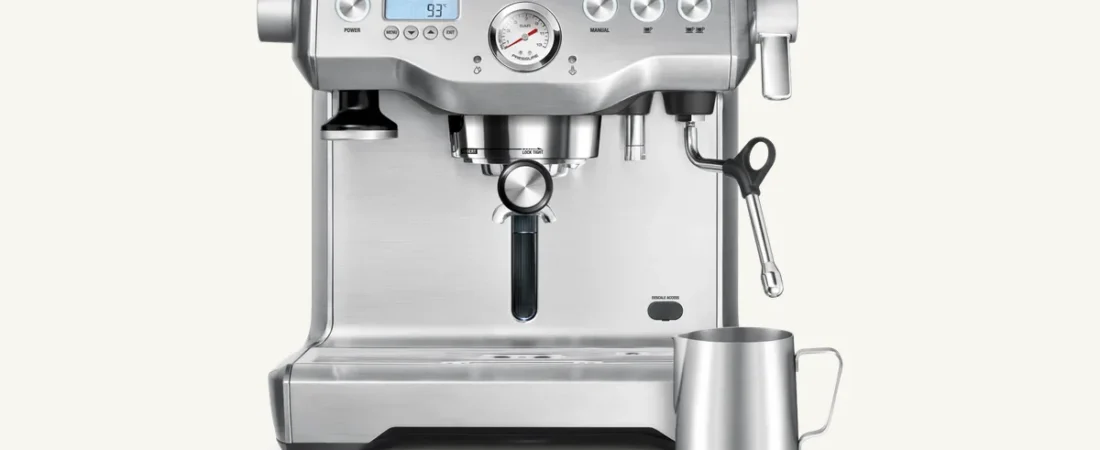
| Breville Dual Boiler BES920XL | Dual | 950 ml steam boiler, PID | ~$1,599.95 | Check Price |
| Rancilio Silvia Pro X | Dual | 0.3 L brew + 1 L steam, two PIDs | ~$1,995 (WLL); ~$2,195 (Amazon) | Check Price |
Dimension 1: Thermal Architecture & Extraction Stability
How a single boiler works
One boiler, one element and two thermostats: one for brewing, one for steam (Clive Coffee). Rancilio’s Silvia workflow is to flip the steam switch, wait for the heating light to go off, purge and steam (Rancilio). You brew before or after, never during. Some models, like the Lelit Victoria, add electronic temperature control that narrows the swing between shots.
How a heat exchanger works
One large boiler stays at steam temperature while fresh brew water runs through a tube inside it, picking up heat without touching the boiler water (Clive Coffee). That is why you can steam and brew at once. The catch: water idling in the tube overheats, so classic HX machines need a cooling flush and hold a temperature range rather than a set point. Clive Coffee notes newer models narrow that range with PID control and three-position switches.
The HX cooling flush: published guidance
- Whole Latte Love (E61 HX): flush until sputtering stops (about 206°F to 207°F), then 5 to 6 seconds more, since each second drops brew water about 1°F, to reach about 201°F. Wait 30 to 45 seconds before brewing. A shot within the last 10 minutes needs a much shorter flush (source).
- Clive Coffee: roughly 5 to 10 seconds before the first shot after idle time (source).
- Seattle Coffee Gear (Diletta Bello): 3 to 5 seconds, then wait 5 to 10 seconds (source).
Some HX machines are engineered around the flush. Lelit’s Mara X manual says its default Xmode Steam brews with a “less stable and precise” profile, while Xmode Coffee switches the element off during brewing to curb overheating (Lelit V2 manual). Lelit’s earlier guide says that in Coffee Mode there is “no need to flush the group” (Lelit guide).
How a dual boiler works
Two boilers, each held at its own temperature, usually with a PID on the brew side. Breville’s Dual Boiler defaults to 200°F, adjusts from 190°F to 205°F, and pairs a 950 ml steam boiler for “instant and continuous steam” with an actively heated group head (Breville manual). No flush, no waiting on a switch.
Dimension 2: Workflow, Warm-Up & Daily Usability
The clearest dividing line is simultaneous brewing and steaming: single boilers cannot, HX and dual boilers can. Gaggia’s Classic Pro manual shows the single-boiler routine: the steam light comes on 15 to 20 seconds after pressing the steam button, steaming should last no longer than 60 seconds, and before the next coffee you run a cup of water through the group to cool the boiler or risk burnt-tasting coffee (Gaggia manual). Fine for one cappuccino; tiresome for four.
Recovery figures are scarce. Whole Latte Love’s 30 to 45 seconds after an HX flush is the main one. Lelit’s Mara X fires its element each time the lever is cycled, holding steam above 1.2 bar for 120 seconds. Breville’s manual describes steam as instant because its steam boiler is always hot.
Published warm-up times: about 3.5 minutes for the Rancilio Silvia and about 6 minutes for the Lelit Victoria (Seattle Coffee Gear listings); about 10 minutes for the Breville Dual Boiler, which Breville suggests auto-starting 15 minutes before use; and up to 24 minutes for the Lelit Mara X (Lelit).
Dimension 3: Build Quality, Maintenance & Repairability
More boilers mean more to protect from scale. Clive Coffee calls water “the single most important thing” for HX owners, recommending filtered, soft water at 35 to 85 ppm and avoiding pure distilled or RO water (source).
- Single boiler: simplest. Gaggia says descale the Classic Pro every 2 months with its descaler, never vinegar.
- Heat exchanger: one large boiler plus, on most models, an E61 group that needs routine backflushing.
- Dual boiler: two boilers and, on the Breville, two pumps. Its guided descale drains both boilers and takes about 1.5 hours; replacing the tank filter every 3 months or 40 L reduces how often you need it.
3-year cost of ownership
Add a capable grinder, water treatment and gaskets to the machine price. On a single boiler, put savings into a dedicated espresso burr grinder. Between HX and dual boilers the gap can be small (Mara X V2 ~$1,359.95 vs. Lelit Elizabeth ~$1,439.95), so let workflow decide. Fresh espresso beans will be the biggest running cost either way.
Single Boiler Deep Dive: Advantages & Drawbacks
The Gaggia Classic Pro (4.3 stars from 3,229 Amazon ratings at the time of writing) and Rancilio Silvia both use 58 mm portafilters and three-way solenoid valves. Our Gaggia Classic Pro review and Rancilio Silvia vs. Profitec GO comparison look at this class of single boiler machine in depth.
Pros
- Lowest price
- Fewest parts and simplest descaling
- Shortest published warm-up times
Cons
- No simultaneous brewing and steaming
- Cool the boiler between milk drinks
- Limited steam; Gaggia caps it at 60 seconds
Who Should NOT Buy the a Single Boiler
- The weekend host making four cappuccinos in a row: the brew-steam-cool cycle repeats every drink.
- The two-latte household: an HX or dual boiler removes the wait.
Better fit: see HX and dual boilers in our prosumer espresso machine guide.
Heat Exchanger Deep Dive: Advantages & Drawbacks
The Lelit Mara X V2 is the value standout thanks to its coffee-priority mode; the Profitec Pro 400 adds PID presets, and the Rocket Appartamento 2.0 keeps a classic, screen-free design. Clive Coffee lists Lelit’s newer MaraX3 at $1,999.95.
Pros
- Brew and steam at once from one boiler
- Large 1.6 to 1.8 L boilers in our examples
- Usually cheaper than comparable dual boilers
Cons
- Classic designs need a flush that varies with idle time
- Brew temperature is a range on most models
- Longest published warm-up (Mara X: up to 24 minutes)
Who Should NOT Buy the a Heat Exchanger
- The light-roast precisionist who adjusts by single degrees: a PID dual boiler does this directly.
- The no-ritual buyer: Clive Coffee names a flush-free workflow as a clear reason to choose a dual boiler.
Better fit: compare dual boilers in our prosumer espresso machine guide.
Dual Boiler Deep Dive: Advantages & Drawbacks
The Breville Dual Boiler BES920XL (4.2 stars from 389 Amazon ratings at the time of writing) adds programmable temperature, pre-infusion and a shot clock. The Lelit Elizabeth is the lowest-priced dual boiler here, and the Rancilio Silvia Pro X pairs a 1 L steam boiler with two PIDs.
Pros
- Independent brew and steam temperatures, no flush
- Brew temperature set to the degree
- Steam ready even mid-shot
Cons
- Highest price
- Two boilers to keep scale-free; Breville’s descale takes about 1.5 hours
- More elements, sensors and pumps to service eventually
Who Should NOT Buy the a Dual Boiler
- The straight-espresso drinker who rarely steams: a single boiler costs far less.
- The tight-budget, small-kitchen buyer: a compact HX like the Mara X keeps simultaneous steaming for less.
Better fit: see our best espresso machines under $1,000.
Single Boiler vs Dual Boiler vs Heat Exchanger: Which Should You Buy?
| If you… | Choose | Example |
|---|---|---|
| Mostly drink espresso or americanos | Single boiler | Lelit Victoria or Rancilio Silvia |
| Make one milk drink a day on the lowest budget | Single boiler | Gaggia Classic Pro |
| Make several milk drinks and want best value | Heat exchanger | Lelit Mara X V2 |
| Want an E61 group and classic Italian look | Heat exchanger | Profitec Pro 400 or Rocket Appartamento 2.0 |
| Brew light roasts and want degree-level control | Dual boiler | Breville Dual Boiler or Lelit Elizabeth |
| Want no flush and a long-term machine | Dual boiler | Rancilio Silvia Pro X |
For full rankings, see our best home espresso machine guide and our best prosumer espresso machine roundup.
Frequently Asked Questions
What is the difference between a single boiler, a heat exchanger and a dual boiler?
A single boiler does both jobs in one boiler, one after the other. A heat exchanger keeps one boiler at steam temperature and heats brew water in a tube running through it, so you can brew and steam at once. A dual boiler has separate brew and steam boilers, each at its own temperature, usually with PID control.
Can you steam milk and pull a shot at the same time on a single boiler?
No. Gaggia’s Classic Pro manual says the steam light comes on 15 to 20 seconds after pressing the steam button, and that you should run a cup of water through the group to cool the boiler before the next coffee.
How long should a heat exchanger cooling flush be?
It depends on the machine and idle time. Clive Coffee suggests roughly 5 to 10 seconds. Whole Latte Love’s E61 method is to flush until sputtering stops, then 5 to 6 seconds more, and wait 30 to 45 seconds before brewing. The Lelit Mara X in coffee-priority mode is designed to skip the flush.
Is a dual boiler worth it over a heat exchanger?
Yes if you make several milk drinks in a row, brew temperature-sensitive light roasts, or never want to time a flush. For one or two drinks per session, a modern temperature-controlled heat exchanger closes much of the gap for less money.
Which boiler type heats up fastest?
Among published figures, single boilers: about 3.5 minutes for the Rancilio Silvia per Seattle Coffee Gear. Breville quotes about 10 minutes for its Dual Boiler, and Lelit up to 24 minutes for the Mara X heat exchanger.